The
Revolutionary
Oscillating Drive
- Efficient
- Quiet
- Resilient
The concept
A special motor for oscillating motion
The starting point for the development of the magler® was the question of how to realise an exceptionally quiet, efficient and permanently overload-resistant oscillating drive.
What does the drive need to achieve?
- Oscillating Motion
Many technical applications do not require a rotating drive but rather a repeating movement within a defined angular range. - Efficient
Particularly in mobile applications with limited installation space and weight constraints, the drive must consume very little energy so that the smallest possible battery can provide the longest possible operating time. - Quiet
Clearly audible drive noise can be disturbing, for example in living and sleeping environments, workplaces, or theatres. To avoid this, the drive must operate quietly. - Resilient
The drive must also be suitable for operation without protective guards. In the event of accidental contact or blockage, neither people, animals nor the drive itself must be harmed through overheating or mechanical overload.
Features
The magler® provides the Answer
The oscillating motor
- The moving component, the pendulum, carries a permanent magnet.
- An electromagnet is integrated into the stationary component.
- The electromagnet is periodically polarity-switched by an electronic control system, causing the permanent magnet of the pendulum to move back and forth between two magnetically defined end positions.
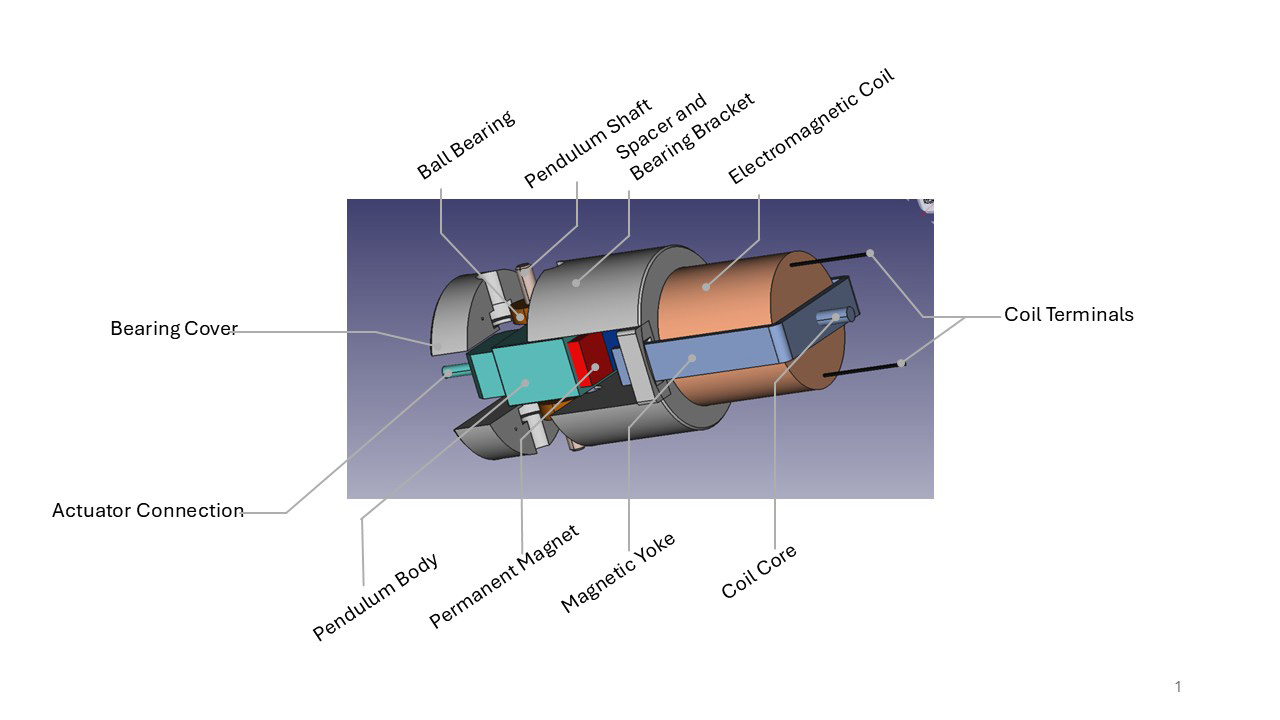

- A short switching pulse is sufficient to initiate movement without requiring a continuous current flow.
- The magler® can be operated directly from a single battery cell from 2.5 V upwards with minimal losses and without the need for a voltage converter.
- The movement of the magler® can be electromechanically modulated from cycle to cycle without delay.
- A wide variety of motion profiles is possible, ranging from simple switching between two end positions to periodic symmetrical or asymmetrical movements and highly complex motion patterns.
- Thanks to its low energy consumption, solar-powered applications are also feasible.

- The magler® operates without physical contact and requires no mechanical end stop. The pendulum is magnetically held at its end position.
- Oscillating motion is generated directly, eliminating the need to convert rotary motor movement using an eccentric mechanism or gearbox.

- If the magler® is externally blocked, this has no effect on the electrical excitation. Neither energy consumption nor temperature increases.
- Thanks to purely magnetic positioning at the end of its motion, the drive remains undamaged even if it is forced beyond its intended end position. The pendulum itself can be stopped safely at any point in its movement due to the magnetic effect, which is comparable to a mechanical slip clutch.
Further Advantages
- Wide mechanical scalability
Depending on the size of the magnet integrated into the pendulum, the magler® can be scaled from very small versions with millimetre-sized magnets to designs with centimetre-sized magnets and, based on current assessments, potentially even beyond. Accordingly, the controllable torque can be scaled across a wide range, from sub-micronewton metres up to the newton-centimetre range. - Low wear
Apart from the bearing on which the pendulum is mounted, the magler® operates entirely without mechanical contact. - Simple and cost-effective manufacturing
The magler® requires only a small number of components. It consists of readily available standard parts such as a permanent magnet, a coil, and an electronic control system. - Investment protection through national and international intellectual property rights
The magler® principle is patented in Europe and China. Additional intellectual property rights, particularly relating to applications in waving table or automatic folding hand fans, have been filed and may still be protected worldwide.
The magler® oscillating drive is the winner of the ElectroTEC Pioneer Award 2025 in the category Power Electronics and Drives.
Potential Applications
What about your application?
Wherever the rotary motion of a conventional electric motor would otherwise need to be converted into oscillating motion by means of a gearbox or eccentric mechanism, the magler® provides a potential alternative.
Possible fields of application
- Oscillating applications with limited size and limited electrical energy capacity
- Solar-powered oscillating drives
- Oscillating motors for continuous operation that is gentle on the target system
- Low-noise drives or actuators for flaps and valves
- Oscillating actuators or oscillating motors for the quiet and efficient generation of dynamic forces
- Compensation or excitation of symmetrical or asymmetrical oscillations in mechanical or acoustic systems
- Drives for low-noise, low-maintenance diaphragm pumps in mobile applications with low energy requirements
- Wear-resistant agitators as a replacement for stirring systems in continuously operated liquid containers
Potential industries
- Automotive
- Aerospace and (autonomous) underwater robotics
- Medical technology, including electric scalpels and mobile low-noise pumps for bodily fluids
- Watches and clocks
- Robotics
- Grinding and polishing technology
- Dental technology
- Industrial production lines
- Household and personal care appliances such as electric shavers, toothbrushes, milk frothers, egg beaters, waving and/or foldable fans, massage devices
- Toys
- Erotic and sex toys or other adult products
Functional prototype: table fan
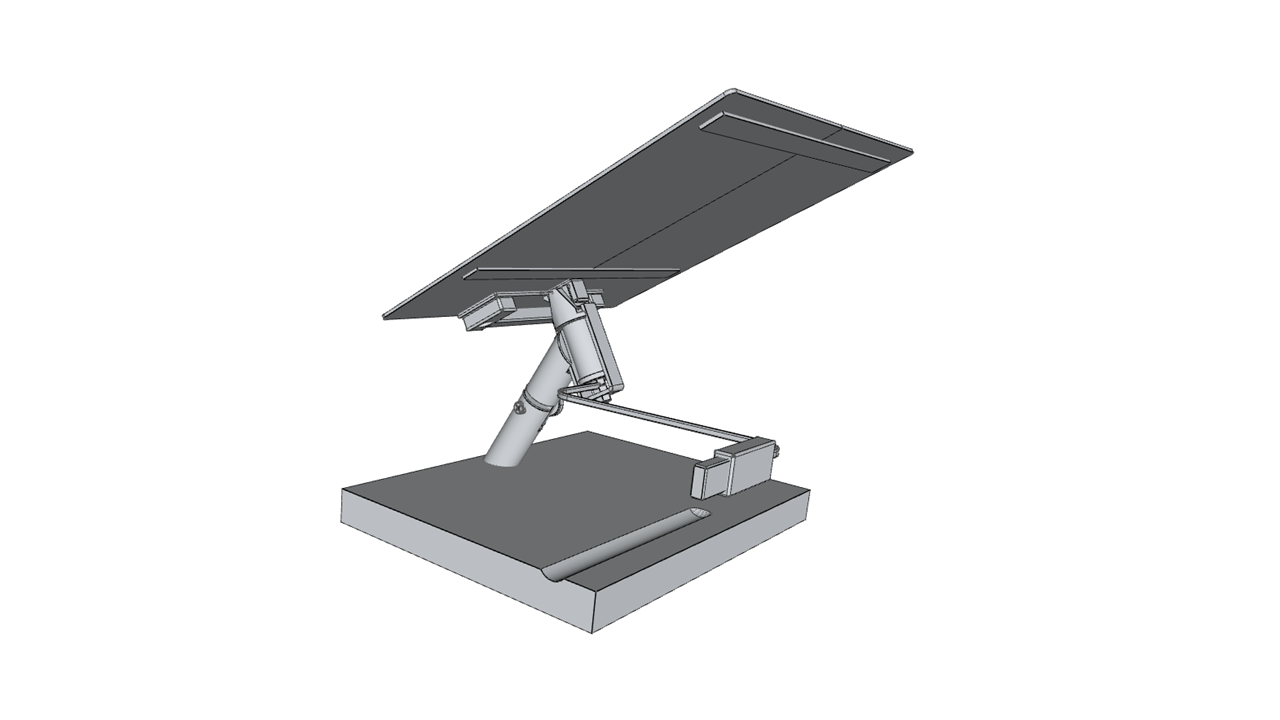
The magler® drive principle is particularly suited to the virtually silent operation of the fan blade of a waving hand fan (e.g. handheld traditional folding fan or a waving table fan) due to its inherent oscillating motion.
The magler®-TF0.9 table fan has been developed up to prototype maturity.
The mechanical components were designed using CAD software and manufactured using 3D printing. Dimensions and electromechanical parameters were optimised through extensive testing. The CAD data is ready for serial production implementation. Electronic control is provided by a microcontroller. The software has been verified. The PCB layout incorporating SMT components and a USB-A interface has been designed, tested and can be implemented in volume production.
Design Study: traditional folding hand fan
A design study for a mobile magler® application using a lightweight and compact 22 g AA lithium-ion cell together with a mounting system for commercially available hand fans has already been successfully demonstrated.
Thanks to the efficiency of the magler® drive, the operating time of the handheld unit exceeds 10 hours using this compact standard battery cell. Further optimisation is possible.
This demonstrates that the magler® drive principle can be implemented in a handbag-sized portable device.
Compared with a conventional axial fan using a propeller, the magler® fan fully exploits the advantages of the drive concept.
With a more comfortable perceived airflow, the magler® fan is orders of magnitude quieter and consumes significantly less energy than a comparable axial fan.
At the same time, the fan is completely safe and highly resilient. Despite its open design, the fan is intrinsically safe against injury. If touched, it simply stops and resumes operation once released, without overloading any component.
The renaissance of the traditional hand fan
The Inventor
The visionary behind the innovation

Edmund Pötsch developed the magler®.
He trained as an electromechanical engineer and completed a degree in Electrical Engineering, graduating with a Dipl.-Ing. (FH).
After two years at sea as Second Engineer aboard tankers operating between Wilhelmshaven and the Persian Gulf, he pursued a successful career within the computer division of Siemens AG.
As a Development Engineer, he managed laboratories and oversaw the market introduction of important product lines at Siemens Nixdorf Informationssysteme AG. He later headed Patent and Licensing Management at Fujitsu Siemens Computers.
He worked both in Germany and at various locations throughout the United States.
Edmund Pötsch is named as inventor on more than 80 registered intellectual property rights in the fields of electromechanics, electronics, power electronics, optoelectronics and computer engineering.
In 1991 he filed an invention relating to an energy-saving mode for CRT monitors. The resulting Powersave Patents (EP 0 624 272 B1 and US 5,774,116) formed the basis of an international VESA standard.
In 1998, the United States Environmental Protection Agency adopted the standard as part of the ENERGY STAR programme for CRT monitors.
In the United States alone, Edmund Pötsch's invention enabled annual electricity savings amounting to several thousand gigawatt-hours, equivalent to the annual electricity generation of a medium-sized German coal-fired power station.
The magler® Team
Expertise and many years of experience
Patents and intellectual property rights

Christian M. Hehn
- Solicitor
- European Patent Attorney
- European Trade Mark and Design Attorney
- Graduate Engineer Dipl. Ing. (University of Applied Sciences)
- Patent Engineer
Intellectual Property Commercialisation

Oliver Pötsch
- Master of Science in Systems Engineering
- Degree in Electrical Engineering (University of Applied Sciences) with bachelor's thesis at the German Aerospace Center (DLR)
- 8 years of power tool development experience at Hilti
Contact
Licensing enquiries
Are you interested in adapting and licensing the magler® principle for your application?
Get in touch with us!
poetsch@heipoe.de